
Professor Dobkowski’s article, “The struggle between truth telling and lying,” presents a deeply flawed understanding of human nature. Citing presidential candidate Dr. Ben Carson’s “possible half-truths” and “exaggerations” about a West Point scholarship and violent tendencies in his youth, Dobkowski claims the media’s reaction to the controversy stems from a recognition that we are all—like Carson—liars.
I am not voting for Carson, but I will defend him. The verbal offer of a “scholarship” to West Point that Carson experienced reflects the same language recruiters used with me when I applied for an appointment in the mid-1970s. And, Carson’s struggle with anger in his youth reflects common sense: What teen reared without a father wouldn’t have anger issues?
(continue reading on the Democrat and Chronicle…)
The post Truth is in our nature appeared first on Peter C. DeMarco.
Ethics is built on trust. Transparency is a key enabler to trust and thus to ethics. Political candidates commit to transparency during their campaigns. Leaders talk about its importance to achieving a healthy culture.
What does transparency mean to your organization? Please click on the link below and take our short EthicsPoll and provide us with your views.
Transparency is the visual side of ethics. When we can see what is going on, we have more confidence that things appear to be as they really are and the less we question the reasons behind what we are being told or what we are telling each other. Transparency is a structural aid to assessing the ethical fiber of a person or organization. There is a certain kind of equality at work that puts a check on unbridled authority.
But all goods have natural limits. We can have too much transparency. Reality TV shows provide ample evidence of how grotesque too much information (TMI!) can be. When a leader discloses the ugly truth about the current state of the organization (the numbers suggest deep financial problem exist) absent a plan to restore health, anxiety increases, panic might set in, threatening the employees’ sense of safety and security. Hope evaporates into hysteria and despair.
Business leaders should take a cue from Ross Baker, a political science professor from Rutgers University who (in a USA today article, “Quit blaming Congress” Thursday, October 27, 2011, p 9A) exposes the problem of being too open while others operate behind closed doors. Baker cited how Congress has lower ratings than the President and the Supreme Court. In his view, the dominant reason for this gap is that Congress plays out on C-span while the other two branches decide things behind closed doors.
To preserve the transcendent nature of the game, the NFL limits the extent of the films it releases for public viewing. The league consciously chooses not to show “All-22” (where you can see all twenty-two players on the field) video footages from its games. One of the reasons cited: “bone head mistakes” by highly paid and highly talented players are out there in the raw, exposed for everyone to see. Unlike the up close videos where you can nearly see the whites of their eyes, players in the “All-22” video appear like little “stick men” on a chessboard. For the NFL, too much transparency harms the myth and mystery of the game.
Sometimes leaders make the mistake of equating transparency with “thinking out loud.” I want my team to know what I am thinking is the leader’s belief that the openness is earning the trust of his followers when, in reality, the opposite is happening. I often coach leaders not to talk so openly. Rather, it is better to listen to what others are saying and respond deliberately and carefully. The words of leaders are amplified by followers. Transparency works best when leaders decide in public and debate in private.
Consider these guidelines for making transparency work in your organization and personal life:
1st: The “seeing is believing” rule. Make as many decisions as possible in the light of day.
2nd: The “need to know” rule: Leaders should divulge information that will help employees work better.
3rd: The “mind your own business!” rule. We should respect a person’s right to privacy and defend our right to not answer questions that another person does not have a right or need to know.
On the whole, more transparency is usually better than less. So, in the spirit of transparency, click the icon below to see what others answered in the opening poll!
Growing up, my friends and I would swear to each other not to tell our parents, teachers, police or someone in authority on a questionable deed one of us had committed. Anyone who told on their buddy was a snitch, a tattle-tale, a rat, or an informer. From the playgrounds and streets of our youth, many of us learn that the ethics of tolerance means not telling on a friend for what he or she has done wrong.
That ethic, “don’t snitch!” still pervades a part of our mindset even in our most powerful and sacred institutions. We tend to tolerate WHAT we know should not be tolerated based on WHO the person is, especially a friend. Because of cowardice, sophisticated rationalizations or the artful ignorance of plausible deniability, we avoid doing the right thing and fail to recognize our cooperation in something bad.
When I was a cadet at West Point, a harsh and unforgiving honor code was required of us: “A cadet will not lie, cheat or steal nor tolerate those who do.” The last part of the code was the most difficult to follow. I can remember cadets being expelled from the Academy for an honor violation in which their moral failing was, simply, tolerating the moral failings of others. One of my daughters, a graduate of the Coast Guard Academy, told me the standards remain tough. She lost classmates to honor violations mostly related to tolerating lies or deceptions by other cadets.
During the ethics education programs we conduct for students at top MBA programs in the country, I tell a personal story about tolerance and ask the session participants to assess my conduct at the time. The story goes like this: As a young infantry lieutenant, I became aware that another officer in my unit, Ted—also a graduate from West Point but a year ahead of me—was fraternizing with a female soldier in the enlisted ranks. Concerned, I confronted Ted and told him I knew about the relationship and that he had to stop it. Ted mockingly told me to “grow-up, we’re not at the Academy anymore!” He insisted the relationship was consensual and, besides, he said, “nobody is getting hurt.”
A week later I confronted Ted again, this time telling him to end his contact with the female soldier or I would have to report him. Ted was defiant and threatened me if I dared to “snitch” on a fellow lieutenant. A few more days passed but Ted continued fraternizing, so I reported him to my commander, a highly decorated Vietnam combat veteran who earned his commission from the officer candidate program (OCS, not the Academy). Then, pausing for a moment in my story, I ask participants to reflect on this question: What do you think my commander said to me?
Usually three responses are offered in the following order of frequency. First, “he got mad at you because you ratted out a fellow officer.” The second response: “He congratulated you on reporting Ted.” But only the third group gets it right, picking up on the key flaw in my reasoning and conduct: “He rebuked you for not reporting the violation immediately.”
If Ted had stopped fraternizing, would that have ended the wrong-doing? In reality, I had tolerated Ted’s behavior by believing if I could get him to stop fraternizing, then I had done my duty. My commander taught me an important lesson: real professional ethics are even more demanding than the rigorous standards of the honor code at West Point.
Today, an incorrect understanding of tolerance continues to confuse our thinking. Well-intentioned diversity programs often fail to distinguish between the WHO and the WHAT of tolerance. We should tolerate reasonable differences among peoples. But ethics also depends upon an understanding of what is universally just. We can never have too much justice so long as the appropriate level of mercy is applied (as my commander demonstrated toward me); but we can certainly have too much tolerance. We should judge WHAT a person does, not WHO they are.
The moral life obligates us to report wrong-doing or harm against our colleagues, customers, shareholders, suppliers or the community. Your organization’s ethics are affected by the members’ tolerance for misconduct.
Below, please take our quick and anonymous poll about the ethics of tolerance. And remember the old adage: what you tolerate … you condone.
Relational trust and organizational trust are dependent on four key stages we call the cycle of trust. Relational trust refers to the ways individuals form relationships necessary for the organization to function as a whole in pursuit of its intended purpose. Organizational trust refers to the ways that individuals outside the organization (customers, shareholders and other stakeholders) come to trust the organization without knowing if it possesses all of the essential parts needed to fulfill its purpose.
A cycle is a series of events that are often repeated in the same order. Trust, as a natural cycle, includes four key events:
- Extending trust: The trustor (the person extending trust) chooses to extend trust. It is the actualization of the trustor’s attitude and judgment through choice (or surrender) toward another person or thing.
- Building trust: Inspiring, gaining and influencing others’ attitudes and judgments of trust through communication (verbal, written, behavioral, etc.).
- Sustaining trust: Reinforcing trust on the deepest level through adherence to the recognized principles and the ethics of the organization.
- Restoring trust: The process of restoring not the trust itself, but the communications that support trust.
The cycle of trust is like any physical workout: It must be eased into carefully to avoid flexing the muscles beyond their ability. In other words, each person first extends trust only to the extent that he or she is freely able to do so. As both trustor and trustee successfully complete each step of the cycle, their trust relationship can be flexed to accommodate greater capacities.
Of course, we must continue to extend trust to develop the trust relationship, but we can also withdraw or begin to qualify the trust we have extended. The second step of the trust cycle, building trust, occurs through continued communications that inspire, gain and influence others’ attitudes and judgments of trust. As we practice these first two steps, we layer on the third, sustaining trust. This step includes a notable addition: The trustor must demonstrate that he or she operates from recognized organizational principles and ethics. While this cycle of trust serves to establish healthy trust relationships, it is never truly complete because it grows through repeating the four stages of extending, building, sustaining and—since no one is perfect—restoring trust when necessary.
Leaders, in particular, must seek meaningful ways to extend, build and sustain trust with others. A practical way to think about trust is to distinguish between how we tend to trust ourselves versus how we tend to trust others. Most people form intentions based on trust in their self-perceived ability to follow through and achieve the intended aim. If a leader mis-judges his own decision-making abilities, even his self¬-trust can be damaged (and rightly so) until he reflects and re-examines the mistake. And, since our actions are the best indication of our nature, followers also distrust a leader who fails to achieve his or her intended results.

Once we understand that others extend trust to us based our actions, then we realize the importance of delivering the necessary results. When these results are good, trust relationships deepen and trust is sustained because the leader’s intent aligns with his or her actions. This understanding is critical for allowing us to extend trust in situations where explicit direction or verifiable results aren’t always available. Of course, no leader is perfect; we all make mistakes or willfully harm others, breaking or damaging trust as a result. In these cases, leaders must both apologize for the damage done and work to restore the trust, using the trust cycle to flex and build the trust relationship.
The best teams build trust because they act on the leader’s intent—empathy is a strong dynamic at work. Followers know what the leader needs, and align their actions accordingly. Reciprocally, the leader understands followers’ intentions, and sustains their trust by ensuring his or her actions and results are aligned with meeting followers’ needs.
This article was originally featured in Trust Inc.: 52 Weeks of Activities and Inspirations for Building Workplace Trust, edited by Barbara Brooks Kimmel. To purchase this insightful publication and learn more about Trust Across America, visit their website.
Do you have a healthy understanding of trust? “Just trust me on this one” or “It’s a slam dunk” are statements too many C-suite executives and boards have come to regret believing. When these individuals accept each others’ word without examining the complexity of the situation, they fall into a trust trap.
Why does this happen? On the surface, getting along is given priority over asking tough questions. Deeper still, how trust is given strengthens or weakens those relationships. Our findings suggest that executives and board members sometimes extend trust toward each other in a way that leaves both in a fragile state.
In the hundreds of sessions we’ve conducted using audience response technology, we find that 50% to 65% of respondents report their approach as trust until proven otherwise. Another 35% to 45% indicate their position as trust but verify. When broken promises and moral injuries occur, executives and board members find themselves bruised by the fall into the trust trap. A trust only if no other choice view forms and along with it, deep skepticism toward each other.
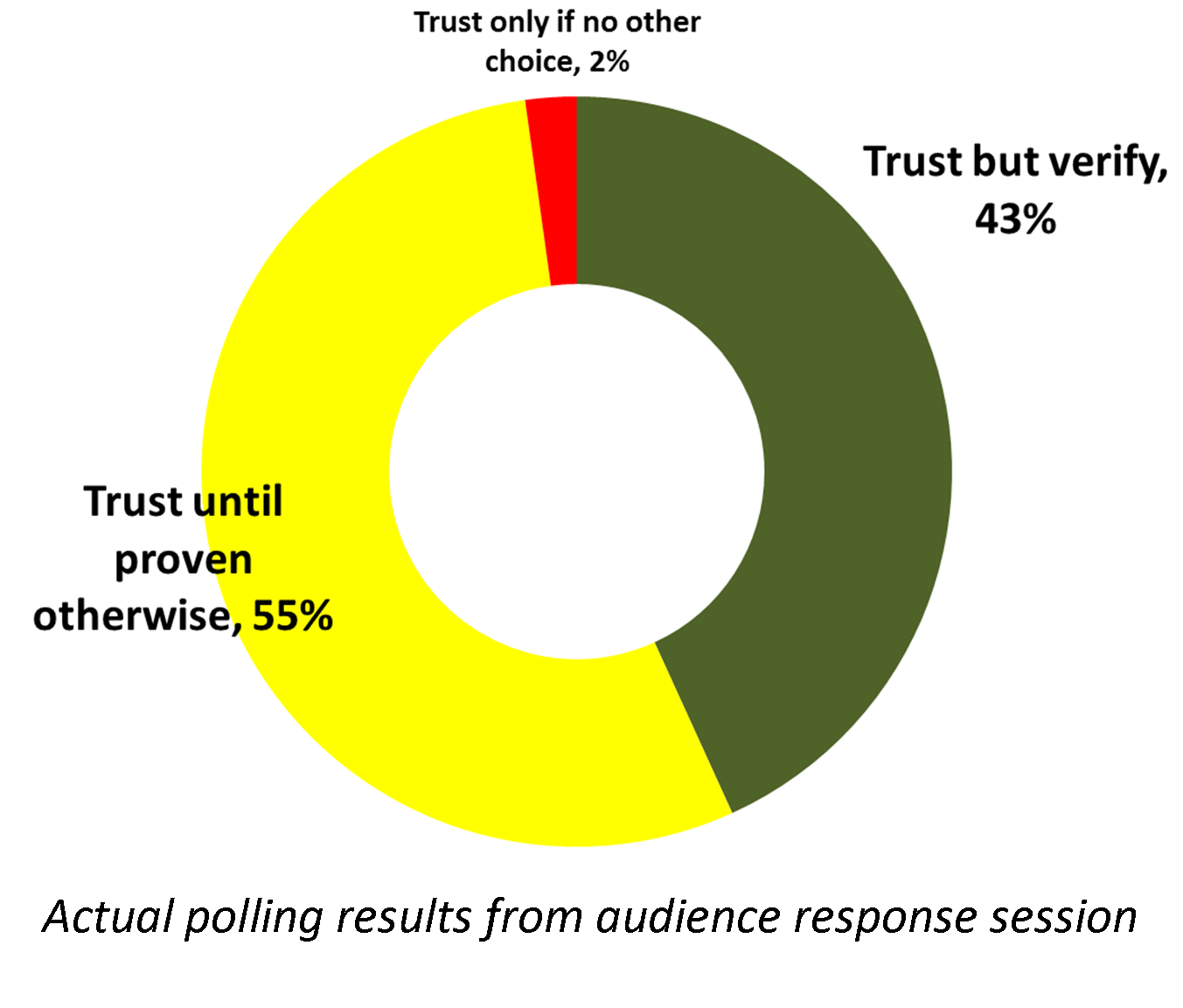
What is the solution? Build trust but verify loops. Trust establishes the boundaries of a communications relationship. Size and frequency determine the quality of the feedback loops between boards and executives. Big issues require detailed questions. Trust failures must be repaired. Increase your frequency of verification to the level of skepticism that exists. Authentic trust builds or declines as a result and a future trust trap is avoided.
This article was originally featured in Trust Inc.: Building Trust for Boards and C-Suites, edited by Barbara Brooks Kimmel. To purchase this insightful publication and learn more about Trust Across America, visit their website.
This article was originally published in the Rochester Business Journal, January 10, 2014 edition.
In his Rochester Business Journal column titled "Acknowledge dishonesty; it’s a starting point for integrity" (RBJ, Dec. 6, 2013), John Engels asked: "Do leaders lie to protect their status as often as it appears?" After an examination of lying and deception in various creatures and in himself, he concludes that lying is, in fact, part of our human nature. I disagree.
Lying, like all evil, is parasitic; it attaches to what is good and true so as to harm or destroy. A lie is a false statement made with the intent to mislead another person. Since the act (or habit) of lying begins with intent, we cannot, as Engels claims, lie "unconsciously." Moreover, not every intentionally misleading statement is a lie; the context and situation matter. We are obligated to tell the truth to those who have a right to know it, but not to those who intend to harm us unjustly.
Engels contends there is "lying in nature" and describes how various creatures use deception. Since animals lack the capacity to reason as we do, they are incapable of lying. The accusing voice of conscience is uniquely human. Moreover, not all deception is lying. Some is justified or necessary. A soldier uses camouflage (like the bugs in Engels’ example) to avoid detection. In a card game, we might bluff. An athlete uses a head-fake to deceive his opponent, suggesting movement in one direction while really meaning to go in another. Would any of us really protest to the referee, "Stop, he lied!"?
Engels suggests that all lies have the same severity, equating President Abraham Lincoln’s "integrity lapse" to pass the 13th Amendment with President Barack Obama’s Affordable Care Act claim that if you like your health plan, you can keep it. Had the president made this statement only a few times, it would have been easier to forgive him. Yet he repeated the claim 36 times, ignoring clear warnings from credible sources and indisputable evidence to the contrary, while deliberately suppressing this information.
Consider the implications of accepting Engels’ conclusion that lying is part of human nature. Someone caught lying might protest: "If lying is a part of who I am, who are you to judge me? You just haven’t acknowledged your own dishonesty or been caught yet." To say none of us is perfectly honest is not proof that dishonesty is our natural inclination. After all, none of us is perfectly healthy, but that does not mean we are all diseased and sick people.
Our nature is to seek health and happiness and to avoid illness. There is basic goodness in each of us, even when masked by darkness in our mind and weakness of will. If we have right reason, then we are naturally receptive to the goods embedded within us and can unlock the moral power to identify good and evil and discern what is in harmony with and what violates human nature.
Engels sees dishonesty in complimenting others contrary to our true thoughts. It is not dishonest to compliment, especially when someone is in need of it. Nor is this a lack of integrity; it is a display of integrity. If you love your Aunt Melinda, you might refrain from telling her that you dislike her signature casserole because you don’t want to hurt her feelings, given her effort to prepare the meal. Honesty does not mean we should make a virtue of bad manners.
Integrity is wholeness of character. It signifies a harmonizing of goods within a person, unifying him or her. Acknowledging dishonesty as Engels does through his own confession promotes an unrealistic transparency and faulty understanding of honesty. One leader I coached had developed the habit of expressing his every thought to his team, believing he was just being honest. Because his emotions were unregulated by right reason, his thoughts appeared arbitrary and artificial, and his team didn’t trust him. In fact, even as he struggled to reclaim his interior life, this leader felt dishonest because he wasn’t being completely honest; such was the level of his confusion.
Our relationships with others are built upon trust, which grows out of truth-telling. If lying is truly part of our nature, then we would not be able to establish real trust; we would never be able to pursue excellence or possess integrity. Instead, we would be consumed by the parasitic power of evil.
And that is the biggest lie.
This article originally appeared in the Rochester Democrat & Chronicle, Sunday August 25, 2013.
The practical benefits of good ethics in business are similar to the importance of proper breathing during physical exercise. Without learning to breathe fully and properly, your exercise regimen will be cumbersome, uncoordinated and unsuccessful. So, too, with a business that does not practice good ethics: every move becomes labored because healthy, cohesive relationships are difficult to establish and maintain.
Economics is the study of how people actually behave in the valuing and exchanging of economic goods and services. Ethics focuses on how one ought to behave during these activities. When your business constantly practices good ethics, it becomes strong, agile, and quick, like a well-conditioned athlete. An ethical team has members who make the right choices by choosing the greater good at stake in each situation. Ethical muscles develop from choosing freely and rightly as a habit, not from blind obedience to authority.
Knowing, wanting, choosing, prioritizing and securing the greater good are the conditioning drills of an ethical organization. It means that every employee knows what is ethical and has developed a desire or passion toward it. He or she chooses the right action, then acts ethically and, ultimately, achieves good and sustainable results or accepts the consequences.
While we tend to trust ourselves by our intentions, we trust others by their actions. When we consistently demonstrate ethical conduct, our colleagues extend us their trust, enabling the organization to work as a unified, healthy body. Each part breathes fully and freely, and activates its potential as it works toward the same aim.
Five benefits flow to those who seek and practice ethical excellence in business:
- Increased KNOWLEDGE of what is good (and bad).
- Established TRUST among the participants.
- Reduced RISK because the more we know the more we can avoid doing the wrong thing.
- Improved PRIORITIZATION because we know how to choose rightly among competing goods.
- Increased PROFIT. A business has an ethical imperative to make money. How we make money affects our reputation and the good will on the balance sheet of our business.
The best businesses teach their employees how to answer the question, “What should I choose?” Employees are at varying levels of moral reasoning, so it helps to have guidelines. Just as athletes learn to understand and respect the rules of the game, employees need common sense policies and codes of conduct to educate and to assist them in building healthy ethical muscles to choose well in their work.
Here are some ways to get started:
- Visit the Rochester Area Business Ethics Foundation (RABEF) website to learn more on how to foster high-standard business ethics within your company or nominate a local organization for its ethical behavior through the annual ETHIE Award.
- Find out how your ethical edge compares with others’ by taking our Ethics Poll Survey
Remember, practice good ethics and the profits will follow.
About thirty years ago, a hearty laugh would follow the combination of the words military and intelligence. “That’s a contradiction in terms!” was the reflexive reply, masking the scars that the atrocities of the Vietnam War had inflicted on the country.
No longer an option of last resort for young people, the military (according to surveys conducted by Harris and Forbes) is one of our most admired institutions. The modern warrior is a highly intelligent and effective ambassador of war and peace.
Today, the combination of the words business and ethics elicits more of a cry than a laugh. While the atrocities and stupidity of a few marred the reputation of the military in the past, the greed of many – consumers, bankers, politicians, and Wall Street titans to name a few – fueled the destructive forces of the Great Recession ravaging the country in the present.
Business, unlike the military, is not a profession. Anyone can go into business and participate in economic activity. To understand what business ethics really is, we need to explore this unique combination of words.
Business is economic activity and the science of economics is the study of how human beings actually behave in valuing and exchanging goods. Ethics, then, is the study of how human beings ought to behave in that same activity.
What a fascinating combination! Aligning what we actually do and what we ought to do. This is the essence of effective ethical leadership: getting your people to do what they ought to do.
Business ethics should be as powerful to your success as military intelligence is to victory on the battlefield today. You can’t win in the market without it!
© EthicsPoll™. All rights reserved.